Recently, I had the pleasure of being interviewed by TheBookSelfBlog. I share a shortened version of our conversation here. You can find the full interview on their blog. Thank you for the opportunity, Athi!
“Back in 2018, Mathias B. Freese reached out to me to review his book And Then I Am Gone: A Walk with Thoreau. I thoroughly enjoyed this book and was only too happy to read and review other books by Freese. Now Freese has released what he considers his last book Straw Shoes.
Long impressed with Freese’s work, I couldn’t help but ask him If he’d be willing to be interviewed for my blog. He gladly said yes, and his thoughtful and wise answers not only give us more insight on Mathias B. Freese as a writer, but also as a fully-dimensional human being.
How did you get into writing?
I did not get into writing. Writing got into me. Looking back, I wish I had a set of drums to let it all out. All of my writing as I look back derives from a need to become aware of myself and the world I live in. It is a sweet curiosity that has led to a lot of good writing. I do my due diligence knowing full well that nothing will be remembered, or is of importance. So why must I feel the need to write? I cannot answer. But I can say that I persevere for in some way writing clarifies who I am. Most if not all of my writing is confessional.
Drive often saw me writing short stories during hall duty as a teacher, on Saturdays, my day off; drive gave me persistence and perseverance. I never thought of myself as a writer or gifted, for this came much later on. The adage says, “We grow old too soon and smart too late.”
How did your personal and professional lives affect your writing?
I wrote for years not as a writer earning his living. I wrote to ease confusion, pain and internal anger and rage. I recall once rewriting a paragraph at least 24 times and it still, although grammatically impeccable, sucked. So green I was I thought grammar made a story. The repetition, a Niagara flow, taught me how to cast out, at last, a decent sentence. As to theme and plot, as to meaning, I had no sense of that as yet. That was tomorrow. Years of wandering. Time may be the writer’s stalwart friend.
Between 18 and 34 I wrote inconsistently but I wrote. What skills I acquired were serendipitous. Writing was my drums. By 34 I had grown, entered therapy, settled down, had children, but whenever I could the infection stayed with me in that I needed or I had to write. Much like a foot fungus I could not get rid of it, a hobby gone wild. I had evolved and I had diversified. I became dimly aware.
From then on, I just wrote to please myself and I wrote whatever came into my heart and soul; I never sold out. My royalties are just enough for an extended lunch at Waffle House. It has been my blessing to knock a book out almost every two or three years in my eighties. No cognitive decline here. I was an existential and analytical psychotherapist for twenty years. Was I terrific? Was I very special? No. I was just good. “Good” is fine with me.
I believe I am a good writer because I write not from my heart but from my soul. [I believe there is a difference; rather I be soul-felt than heartfelt.]
And I really don’t care if you like my work or not. Don’t you realize I am healing myself? Make way.
Describe your latest book.
Between 1969 and 1972 I worked as a curricula writer on a Title III federal project designed to create racial and ethnic materials for the local school districts on Long Island, NY. In this capacity it was my good fortune to meet with Betty Lee Sung, a librarian in Freeport. She had published Mountain of Gold. I interviewed her. Based on that, I wrote a short story about Chinese working on the railroad; that morphed into a novel and I later submitted as my master’s thesis at SUNY at Stony Brook. I tried to have it published, but it was rejected. However, I was informed it was more than a worthy effort. I put it away for over five decades.
When I wrote Sojourner, and only recently after editing changed the title to Straw Shoes, I was seeking meaning in my own life. The book is very much a book of that time in my life—the book of a young man—in which I was seeking meaning, purpose, and intention so as to align myself for the adventure that lay ahead. The adventure is coming to a close. Like all or most of my writing, the book is an explanation I give myself for what is my life.
Straw Shoes really posed this question: “what is one to do during this short sojourn?” There was a taste of despair in this, an undercoating of depression as if life was dull without patina, unlived would be the better way to express it. It is more than fifty years ago but right now I can just taste a bit of that despair so I set out to write my way not out of it but to sink into this sargasso sea and muddle through.
I put the book away for decades, never really thought about it. I viewed it as my first novel and a training ground for me as a writer. I underestimated its worth. That was a delightful mistake. Now in my eighties I retrieved it one day and wondered if it needed to be dusted off, tuned and lubricated. I asked my editor to read it. The fear was that I was coasting, resurrecting old stuff instead of inventing new. He felt it had much merit. I was taken by that, feeling it was amateurish. But I am the last one to know, often desiring to be the first to know about me! So I went at it like taking a Publix roasted chicken apart; I pulled here, tore there, dropped that, and really, I discovered, there was not much to do. The book stood on its own merits. This pleased me after reading it twice after publication. Not bad, I thought.
Why do you think it will be your last book?
It is my final book as costs and the weird turn of publicity has become so much over my head that I feel I am attached to a digital leash. That is another essay. I am feeling much like Kurt Vonnegut who stopped writing because he felt he had spent all his savings. In part I say enough is enough; be an artist in the way you go about your life. Have no fear. I will continue to write.
What inspired you to write on so many topics and in so many genres?
Not by intent, that is for sure. Serendipity is my steed. I free associate a lot before I write and when I go down the Mississippi. I let the raft follow the river’s course. I have never felt I was a professional author. I just went my unruly way. You cannot harness a free association. You can suck it dry for inspiration. I say forget plot and follow association or stream of consciousness. Be brave.
Any new non-book related projects on the horizon? What will you do if you’re not writing?
I lived and existed before TV. Before TV, I read, I actually played! Radio made me imagine Superman’s flight. I sucked on the analog teat and I can read and write, thank goodness. “Secondary gain” is the psychoanalytic term for deriving an unplanned reward from an activity. The secondary gain for cellphone use is to coalesce and coagulate about emptiness.
In my time, the secondary gain for empty time was reading books that had pages and listening et al. All I needed as a young boy was a rubber ball as I walked the streets of my community. I created play. Rubber balls have disappeared. And so much creativity has died. The interviewer did not mean to be funny or inane by asking, “What will I do if I no longer am writing? I will live. Writing is not life, never will be. It is the secondary gain of living life. Read Krishnamurti’s, Think on These Things. He does a better job of it than I can.
What will you do if you’re motivated to write again? What if that muse visits once again?
Will I ever write again? Yes. Does my heart pump blood? Allow me to put it this way. If all my books were set before me and incinerated, I would not shed a tear. We are all evanescent. Why not consider wonderful books the ashes of wonderful imaginings by creative people? We live a cosmic hoax. Birth. Life. Death. In the time I have left I wish only to suck out the marrow of existence, moment to moment.
What advice would you give to aspiring writers?
Advice sucks. What good is it? Why follow another human being’s patterns or idiosyncrasies? Become a better listener or what Theodore Reik called listening with the third ear. Thoreau said it best when he chose to take his own guidance and entered the woods to live deliberately. Do you realize that this adverb is one of the greatest ever used in literature? I am off to see the wizard.
Thank you again to TheBookSelfBlog for the chance to discuss my life and work. Please check out the full post and their other essays on their website. And find a copy of Straw Shoes through the link below.
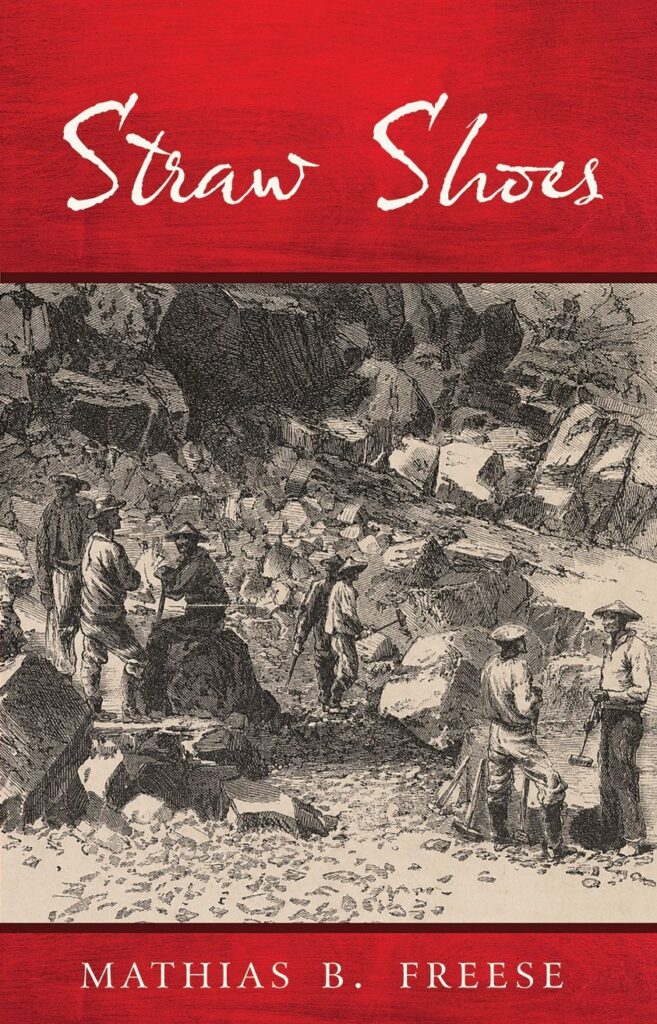
When you realize that every day of the rest of your life will look the same, how do you face each dawn?
In the dusty, golden fields of 19th-century China, Ah Ling rankles at the daily duties and monotonies which chain his mind and being. The eldest son of an ailing father, he has always chosen the responsible way, working himself to the bone to feed his parents, wife, and brother. But Ah’s mind seeks to fly away on wings, to know the nature of the world and his own self.
When his wife gives birth to a girl, dashing Ah’s hope of future hands in the fields, he gambles with Fate, leaving his ancestral shores for the brutal promise of Gold Rush–era San Francisco. Restless and yearning for completion, Ah seeks more than the quick and dangerous American money which could change his family’s fortunes. But what meaning and hope can he grasp in the treacherous crags of Cape Horn, daily christened by the blood and sweat of his countrymen?
As Ah Ling forms bonds with his fellow railway workers and tests what the Tao Te Ching teaches about being, he must confront the value of what he has left behind, and whether he can ever regain it.
Leave a Reply