5 Stars!
Review by Noémie Media
Mathias B. Freese’s Straw Shoes is a remarkable literary achievement that transcends the boundaries of historical fiction to become something far more profound. It is a meditation on duality, resilience, and the eternal human struggle between surrender and defiance. Freese, a teacher, psychotherapist, and author of ten books, has crafted what may very well be his finest work to date, a novel that speaks in a voice both youthful and ancient, shaped by decades of introspection and hard-won wisdom.
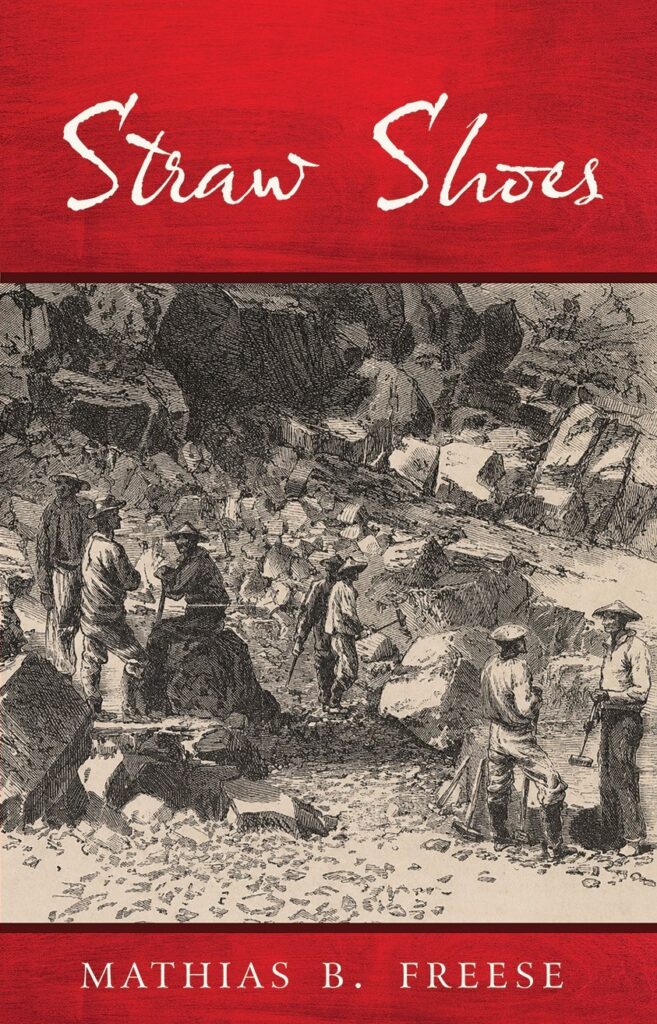
The story follows Ah Ling, a 19th century Chinese farmer who makes the fateful decision to leave his fields in Taishan, China for the brutal promise of Gold Rush era San Francisco. He trades yielding soil for unyielding granite, farming rock instead of rice, survival instead of certainty. But this is not merely a tale of immigration and hardship. It is a meditation on duality: soil and stone, anchor and ascent, softness and strength. As the Tao Te Ching teaches, the weak may overcome the strong, and water wears away stone. Freese captures this philosophy beautifully as he traces Ah Ling’s physical and spiritual journey across continents and through the trials of a harsh new world.
Freese’s prose is nothing short of exquisite. His eloquent words are never presumptuous or distancing, but instead invite us into the sphere of his insightful mind. From the opening lines, the reader is transported into Ah Ling’s world: “Sky and earth merged at the far reaches of Ah Ling’s land, an insignificant parcel of Taishan, China. As he walked the fields, he spoke to his shadow. ‘When does it begin?’ he asked. ‘And where does it come from?’” This poetic, contemplative tone permeates the entire novel, grounding the reader in a consciousness that is both deeply personal and universally resonant.
The author’s abiding interest in Eastern thought is woven seamlessly into the narrative. Freese, who has led workshops on experiential and psycho-spiritual approaches to inner awareness, brings a depth of philosophical insight that elevates this novel beyond mere storytelling. The dialogues, mentor pairings, and metaphysical turns that characterize his signature style are present here in full force, creating a reading experience that is as intellectually stimulating as it is emotionally moving.
What makes Straw Shoes truly special is the sense that it was written across decades, by the man Freese was and the elder he became. This is a novel that carries the weight of a lifetime of reflection and growth. The farmer who hews cliffs mirrors the author who has weathered time’s conferring insight, hard-earned and deeply felt. There is a gentle mastery in the way Freese handles his material, a wisdom that comes not from academic study alone but from lived experience.
Leave a Reply